

 Download Product Sheet
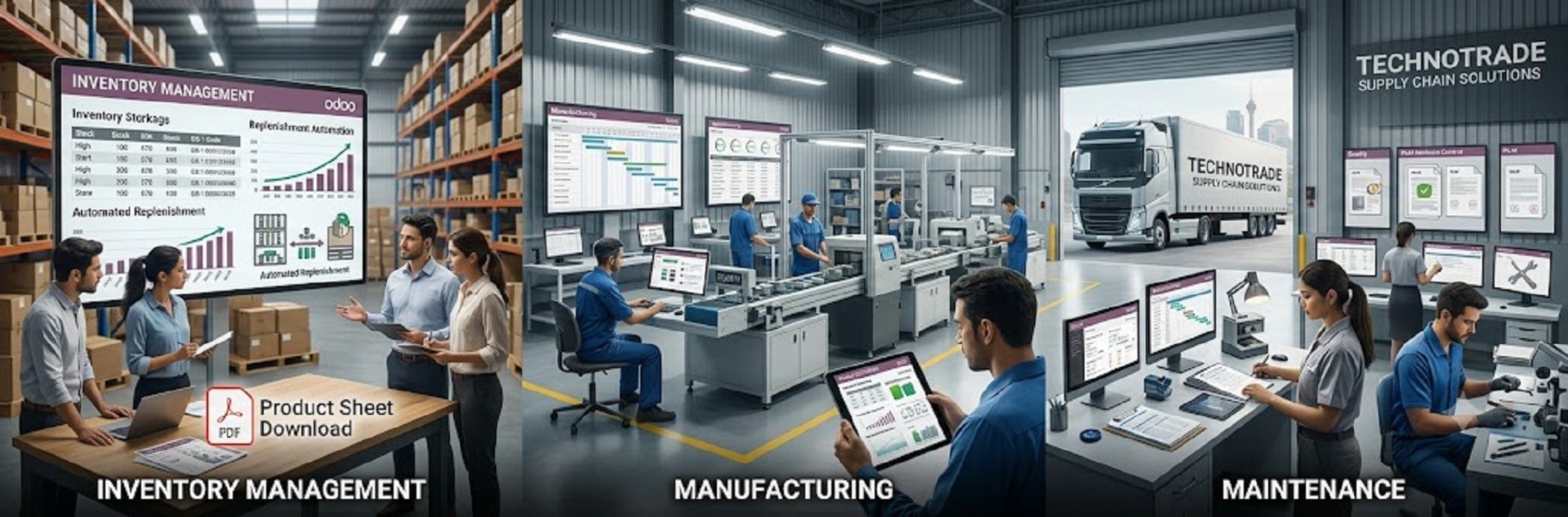
 Experience Odoo’s integrated suite of supply chain apps designed to streamline every aspect of your operations. From inventory management and manufacturing to product lifecycle management (PLM), purchasing, maintenance, quality control, and MES (Manufacturing Execution System), our Supply Chain suite provides comprehensive tools to enhance efficiency and productivity.
Whether you’re managing stock levels, optimizing production processes, ensuring product quality, or tracking maintenance activities, Odoo equips your business with powerful solutions for seamless supply chain management. Discover how Odoo transforms complexity into streamlined operations across your entire supply chain.
Here are the details of each of the Supply Chain Apps featured:
1. Inventory
- Overview: Provides real-time tracking, automated restocking, and optimized storage strategies.
- Key Features:
- Replenishment Automation: Uses min-max strategies, MTO (Make-to-Order), or master production schedules to automate purchase orders and vendor follow-ups.
- Storage Optimization: Implements push/pull rules, GS-1 codes, customizable routes, and put-away strategies (such as fast/slow movers and ABC analysis) to optimize movement.
- Real-Time Tracking: Monitors serial numbers, lots, packaging, and stock across multiple warehouses or companies.
- Picking & Packing: Supports single, cluster, wave, or batch picking, with carrier integration for shipping labels and quality control.
- Repairs Integration: Connects with the Repairs app to easily handle damaged or broken items.
2. Manufacturing
- Overview: Offers real-time capacity planning, component availability tracking, and cost control for efficient order simulation and resource management.
- Key Features:
- Production Planning: Manages production orders, Bills of Materials (BOMs), and work centers with Gantt charts and finite capacity scheduling.
- Shop Floor Control: Features a tablet-optimized dashboard for paperless operations, work instructions, quality issue reporting, and maintenance requests.
- Integration & Hardware: Integrates with Inventory, uses barcodes to process manufacturing orders, and connects external devices via the IoT Box.
- Reporting: Generates detailed reports to analyze production performance and identify bottlenecks.
3. Purchase
- Overview: Streamlines procurement processes through automated RFQs, flexible vendor agreements, and automated billing.
- Key Features:
- Purchase Optimization: Allows creating custom agreements, comparing vendor quotes, and automating recurring orders.
- Order & Vendor Management: Tracks requests, orders, and invoices while running tenders and evaluating vendor performance.
- Inventory Integration: Monitors stock levels and automatically generates purchase orders when inventory runs low.
- Flexible Billing: Generates invoices based on preferred terms, allowing split bills or paying for ordered vs. received quantities.
4. Maintenance
- Overview: Focuses on equipment maintenance management and improving Overall Equipment Effectiveness (OEE).
- Key Features:
- Preventive Maintenance: Automatically schedules preventive maintenance by predicting equipment failures using MTBF (Mean Time Between Failures) and MTTR (Mean Time to Repair) metrics.
- Work Order & Material Management: Converts requests directly into work orders and material requisitions for smooth execution.
- Collaboration & Tracking: Uses Kanban boards, calendar views, and a mobile interface to streamline communication.
- Performance Reporting: Provides key performance indicator (KPI) reports to optimize maintenance practices.
5. Quality
- Overview: Ensures consistent product quality by using configurable quality checks across manufacturing and inventory orders.
- Key Features:
- Quality Control Points & Checks: Triggers inspections at key stages and records pass/fail or measurement results via interactive worksheets.
- Quality Alerts: Notifies teams of potential defect issues and categorizes them by urgency.
- Team Management & Reporting: Allows setting up dedicated teams for specific products/operations and generates reports to track quality trends, identify root causes, and suggest corrective actions.
6. PLM (Product Lifecycle Management)
- Overview: Manages product design revisions, real-time collaboration, and engineering changes to keep engineering aligned with manufacturing.
- Key Features:
- Version Control: Manages design revisions and related document versions.
- BOM Management: Integrates directly with CAD software to maintain accurate Bills of Materials as changes occur.
- Engineering Change Management (ECM): Streamlines change request approvals and tracks their direct impact on BOMs.
- Communication: Facilitates real-time cross-departmental discussions and notifications.
7. MES (Manufacturing Execution System)
- Overview: Acts as the central nervous system for the factory floor, monitoring real-time operations and controlling production tasks to boost efficiency.
- Key Features:
- Real-Time Monitoring: Offers full visibility into factory floor operations for rapid issue resolution.
- Work Order Scheduling: Organizes work orders, schedules production tasks, and assigns work directly to operators.
- IoT & Hardware Integration: Integrates with IoT sensors and machine devices to gather real-time data.
- Shop Floor Interface: Uses a tablet-friendly UI to allow workers and management to communicate and execute tasks efficiently on the shop floor.