

 Download Product Sheet
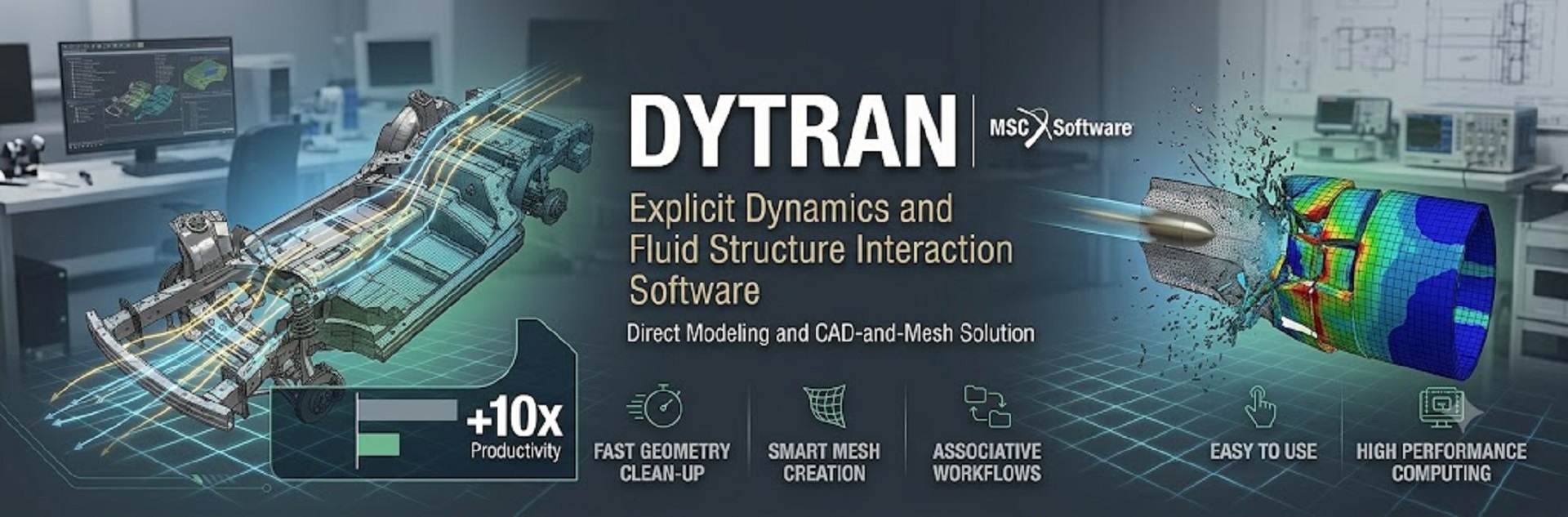
 Dytran is an explicit finite element analysis (FEA) solution to simulate short-duration events like impact and crash, and to analyze the complex nonlinear behavior that structures undergo during these events. Dytran enables engineers to study the structural integrity of designs to ensure that final products meet customer safety, reliability, and regulatory requirements.
Dytran delivers structural, material flow and coupled FSI analysis capabilities in a single package. Using a unique coupling feature that enables integrated analysis of structural components with fluids and highly deformed materials in one continuous simulation, Dytran provides realistic solution to complex problems.
• Transient structural analysis: Using explicit solver technology, Dytran provides faster solution to large, complex transient dynamic problems. Users can use from a wide variety of elements that include solid, shell, beam, membrane, connectors and rigid elements, to model the structures.
• Nonlinear materials: Select from a wide range of material models to model the nonlinear response and failure. The available material models include linear elasticity, yield criteria, equations of state, failure and spall models, explosive burn models and composite materials to name a few.
• Contact analysis: Model interaction between multiple parts and assemblies with robust contact analysis capability. The interaction may include frictionless contact, sliding with frictional effects and separation. Single surface contact can also be used to model buckling of structures where structures may fold onto themselves.
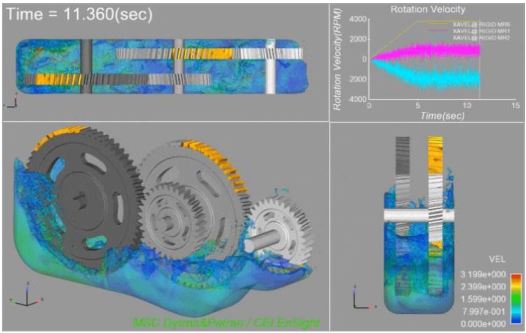
• Fluid-structure interaction: Analyze fluid behavior and its effects on structural response in a single model with the help of a combination of Lagrangian and Eulerian solvers in Dytran. Interaction between the fluids and structures is achieved through a coupling surface created on structures.
• High performance computing: Achieve higher productivity by taking advantage of the latest numerical methods and high performance computer hardware. Analyses can be run on a broad range of machines including desktop computers to supercomputers. Users can also benefit from the parallel processing capabilities to achieve faster solutions.