

 Download Product Sheet
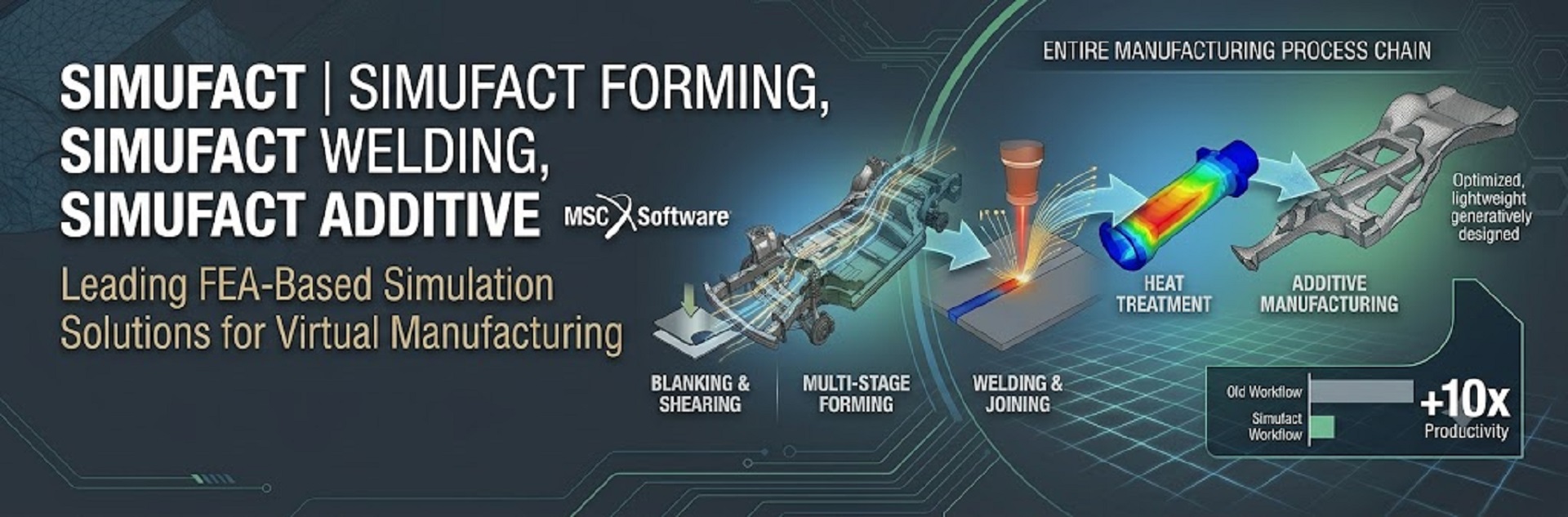
 Simufact is a leading FEA based simulation solution for metal forming, joining, welding and metal-based additive manufacturing. With the ability to simulate the entire manufacturing process chain, starting from blanking, shearing of wires or billets, to multi-stage forming, punching, trimming, and heat treatment followed by joining operations, welding and structural analysis, Simufact helps optimize the manufacturing processes, and reduce costs and time-to-market, while improving product quality.
Simufact Forming:
Simufact Forming is an established software solution for the simulation of forming manufacturing processes. The software covers all essential areas of forming technology: forging, cold forming, sheet metal forming, all rolling processes, open die forging and mechanical joining, to name only the most important processes. Simufact Forming provides support in microstructure simulation, calculation of die load, material flow and prediction of material properties in the course of conventional and inductive heat treatment. Furthermore, thermo-mechanical joining methods of pressure welding are also supported.
Simufact Welding:
Simufact Welding is used to model and calculate a wide range of thermal joining processes by means of the welding structure simulation under consideration of weld sequence and clamping. Processes such as arc welding, laser beam welding, electron beam welding, brazing as well as resistance spot welding can be modeled in Simufact Welding. A new field of application is the simulation of deposition welding and modeling of the generative manufacturing process ‘Direct Energy Deposition’ (DED). In addition, Simufact Welding can be used to model the heat treatment, different variants for cooling and unclamping as well as the mechanical load on welded structures. Simufact Welding uses a scalable calculation approach with which the calculation speed and accuracy can be controlled as required.
Simufact Additive:
Simufact Additive is a scalable software solution for the simulation of metal-based additive manufacturing processes which focuses on powder bed melting processes. With the macroscopic approach, users obtain simulation results within minutes that predict the tendency of stresses and distortions. Furthermore, thermal or thermo-mechanical calculations can be performed to obtain precise results which consider the temperature distribution during the process.